
You know, it’s funny how in the world of software, we often fall into the trap of using a tool simply because it’s the easiest one at hand. It’s like my mausi (aunt) who insists on using a pressure cooker for everything, even to boil just an egg! It works, but it’s not always the best tool for the job. Similarly, in recent program discussions, I found myselves in a bit of a sticky wicket with a common integration pattern: webhooks. The recurring issues of latency and bottlenecks have raised some serious questions. So, let’s peel back the layers and see how we can build more resilient systems by moving beyond webhooks and embracing a more robust architectural pattern: Pub/Sub.
Software Architecture Pattern – Pub/Sub
The Pub/Sub (Publish/Subscribe) pattern is a communication model where systems are decoupled. Think of it like a newspaper. A journalist (the publisher) writes an article on a specific topic – say, soccer. The newspaper’s circulation department (the message broker) then distributes this article to everyone who has subscribed to the sports section (the subscribers). The journalist doesn’t care who reads the article or when, their job is done once they hand it over. This decoupling allows for greater scalability, flexibility, and fault tolerance.
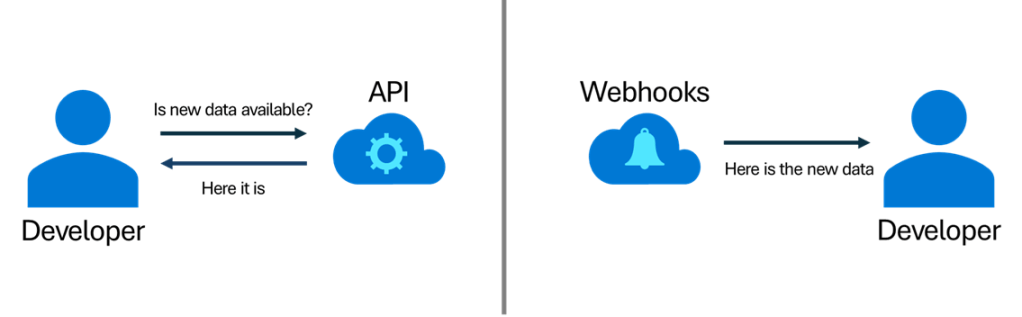
What is a Webhook?
A webhook is a way for an application to get real-time data from another. It’s like a friend calling you up the moment a juicy piece of gossip is out, instead of you having to call them every five minutes to check. The provider system sends an HTTP POST request to a predefined URL (the webhook endpoint) on the consumer system as soon as an event occurs.
How do Webhooks Work?
- Subscription: The consumer system tells the provider, “Hey, here’s my URL. Send me updates here.”
- Event Trigger: An event happens in the provider system.
- HTTP Request: The provider sends an HTTP POST request with the event data to the consumer’s URL.
- Processing: The consumer processes the data.
- Acknowledgement: The consumer sends back an HTTP status code, like a “200 OK,” to confirm receipt.
Advantages of Webhooks
- Real-time Data: Get updates as they happen.
- Reduced Overhead: No need for constant polling, which saves resources.
- Simplicity: For simple integrations, they are easy to set up.
Limitations of Webhooks
- Reliability: What if the consumer is down when the webhook arrives? The message could be lost forever. It’s like a missed call; unless the other person tries again, you’ll never know what they wanted to tell you.
- Bottlenecks: If the consumer system gets a flood of webhooks, it might get overwhelmed and crash. The provider’s performance is now at the mercy of the consumer.
- Security: Ensuring the webhook request is legitimate can be tricky.
- Troubleshooting: Finding the root cause of a failed webhook can be a nightmare in a distributed system.
Key Architectural Considerations
To build a more resilient system, especially in a high-traffic environment, we need to move away from the “all eggs in one basket” approach of direct webhook calls.
- Asynchronous Processing
- Why? The publisher should not have to wait for the subscriber to process the message. When an event happens, the publisher just sends it and moves on. This prevents the publisher from becoming a bottleneck.
- How? This requires setting up and managing a message broker or queue.
- Message Queues
- Why? A message queue acts as a buffer. If the consumer is busy or down, messages just sit in the queue waiting. It’s a lifesaver, ensuring no data is lost.
- How? For cloud-based solutions, consider AWS SQS, Azure Service Bus, or Google Cloud Pub/Sub. For self-hosted solutions, RabbitMQ or Apache Kafka are popular choices. The key is to select a queueing system that offers features like message durability (to prevent data loss) and dead-letter queues (to handle persistently failing messages).
- Retry Mechanism
- Why? Failures are a fact of life. A retry mechanism with exponential backoff ensures that if a delivery fails, the system tries again after an increasing delay. This gives the consumer time to recover.
- How? Implement a retry policy that uses exponential backoff. This prevents all failed requests from retrying at the exact same time, which could cause a “retry storm”. Use a finite number of retries, and if a message still fails, move it to a dead-letter queue for manual inspection.
- Rate Limiting
- Why? To prevent both the publisher and subscriber from being overwhelmed. You don’t want a sudden flood of messages taking down your systems. This helps maintain a stable, predictable flow.
- How? You can implement rate limiting using various algorithms. The token bucket algorithm is a popular choice, where requests consume “tokens” from a bucket that is refilled at a constant rate. The leaky bucket algorithm is another option, which processes requests at a steady, fixed rate.
Monitoring and Metrics
You can’t fix what you can’t see! Comprehensive monitoring is crucial. You should track,
- Delivery Success Rate: How many messages are reaching their destination, by measuring Percentage of webhooks delivered vs. attempted.
- Delivery Latency: Is the delivery fast enough, by measuring Time taken from event to ingestion by receiver.
- Retry Rate: Are we seeing a lot of retries? This could indicate an issue. Measure frequency of attempted redeliveries.
- Queue Length: Is the queue growing? A long queue is a red flag. Measure backlog of undelivered messages.
- Payload Size: Measure average or peak data size per message.
- Resource Utilization: Are our systems under strain? Monitor CPU, memory, network, especially under burst load.
Robust monitoring and alerting are critical for production-grade integrations.
Conclusion
So, what’s the takeaway? While webhooks are handy for simple, low-stakes integrations, for anything critical or high-volume, they are like my aunty’s pressure cooker – a quick fix that might cause more trouble than it’s worth. By adopting a Pub/Sub model and incorporating key architectural considerations with solid solutions for message queues and retry mechanisms, we can build systems that are not just functional, but also resilient, scalable, and robust enough to handle the pressures of the modern digital world. It’s about choosing the right tool for the job, and for building reliable integrations, that tool is a well-designed Pub/Sub architecture.
#SoftwareArchitecture #Integration #PubSub #Webhooks #APIs #SystemDesign #AsynchronousProcessing







 Manish's - Thoughts and Learnings
Leave a comment