
Just finished a tough week on an IT project. You know the kind – deadlines keep slipping, bugs pop up everywhere and figuring out who’s in charge of what is harder than solving a Rubik’s Cube. Basically, it’s a mess!
And it got me thinking, while sipping my evening coffee, about something cool: Chaos Theory. No, I’m not talking about Ryan Reynolds movie. I’m talking about branch of mathematics, where deterministic laws of dynamical systems can help us understand our messy projects.
For those who skipped mathematics class, Chaos Theory isn’t about everything being random. It’s about systems that follow rules but still become super hard to predict because even tiny changes at the start can cause big problems later. Sound familiar?
Let’s look at how some of Chaos Theory’s main ideas can explain our project problems,
Rules, But Still Unpredictable: “We Knew the Rules, But What Went Wrong?!”
Our project has rules, right? Like how we develop software, how we work together, how we use our project tools, all set ways of doing things. But even with all the right steps, we often end up with a mess instead of a perfect project. Why? Because the project system is complex, with lots of moving parts (teams, people, old code, other systems we rely on, even coffee breaks 😊).
- Project Talk: We planned for X, but then Y, Z, and then A, B, C happened. The system follows rules, but with so many things happening at once, it’s impossible to predict the future far ahead.
- What we learn: Be flexible and ready to change. Don’t stick to an old plan like it’s the only way. Be ready to change direction and accept that some things will be unpredictable in big, spread-out projects. Being flexible is key!
The Butterfly Effect: Or, “Who Forgot the Semicolon?!”
We’ve all heard the story: a butterfly flaps its wings in one place and causes a storm somewhere else. In our IT world, it’s more like – a small change by a new developer, if not checked, can quickly lead to many serious bugs in different parts of the system.
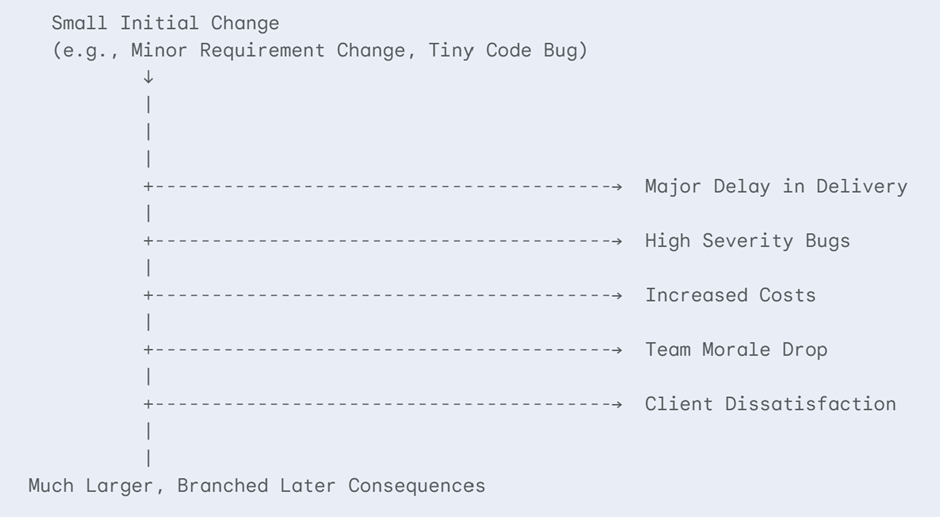
- Project Talk: Remember that “small change” that wasn’t “a big deal” two months ago? Yep, that was our butterfly. Now, we’re stuck in a storm.
- What we learn: Being very precise at the start (meaning crystal-clear requirements, well-documented interfaces between modules, thorough unit testing that considers cross-module impacts, and strict code review processes across all teams) isn’t just nice to have, it’s a must. Even seemingly insignificant oversights can have massive ripple effects in complex, distributed systems. Simple rule: Measure twice, cut once… and test everything thoroughly across all integrated parts!
Strange Attractors: “Why Do We Always End Up in the Same Mess?”
In Chaos Theory, systems can be pulled towards “strange attractors” – complex patterns they keep coming back to. Think of it like a swing that never stops in one place but always follows a unique, detailed path.
- Project Talk: Have you noticed how, even with new teams and processes, your projects keep hitting the same snags? Like communication problems between certain teams that just won’t go away? Or the same kind of bug popping up in different areas? That, my friends, might be your project’s strange attractor!
- What we learn: Find these repeating patterns. Are they because of old habits? Bad ways of talking to each other? Not enough written information? See these “attractors” and work hard to stop them. Otherwise, we’ll keep making the same mistakes. Time to break free from project déjà vu!
Fractals: “Zoom In, Zoom Out, Still Confused!”
Fractals are cool shapes that look the same no matter how much you zoom in or out. In our projects, often the big chaos (like the whole project timeline) looks just like the small chaos (like one week’s plan, or even a daily meeting!).
- Project Talk: If your weekly planning is a mess, chances are your overall project plan will also be a mess. If your team meetings are unorganized, don’t expect the meetings with other teams to be great either. The messiness often looks the same at all levels.
- What we learn: Fix the chaos at every level. Small improvements in daily habits and team talks can make things better overall. And fixing small problems, can bring clarity to the bigger ones. Every little bit helps, like adding a small spice to make the whole dish taste better!
So, next time your project feels like it’s going crazy, take a deep breath. It’s not just random. It might be following the detailed, unpredictable, but oddly patterned dance of Chaos Theory.
Understanding these ideas won’t magically solve all our problems, but it gives us a way to look at things, adapt, and maybe even find some interesting order in the complex beast that is a big IT project.
What do you think? Have you seen the “butterfly effect” in your projects? Share your stories (and tips!) in the comments below!
All the best, and hope your projects find their balance!
#ChaosTheory #ITProjects #ProjectManagement #DigitalTransformation #Agile #Teamwork #Leadership







 Manish's - Thoughts and Learnings
Leave a comment