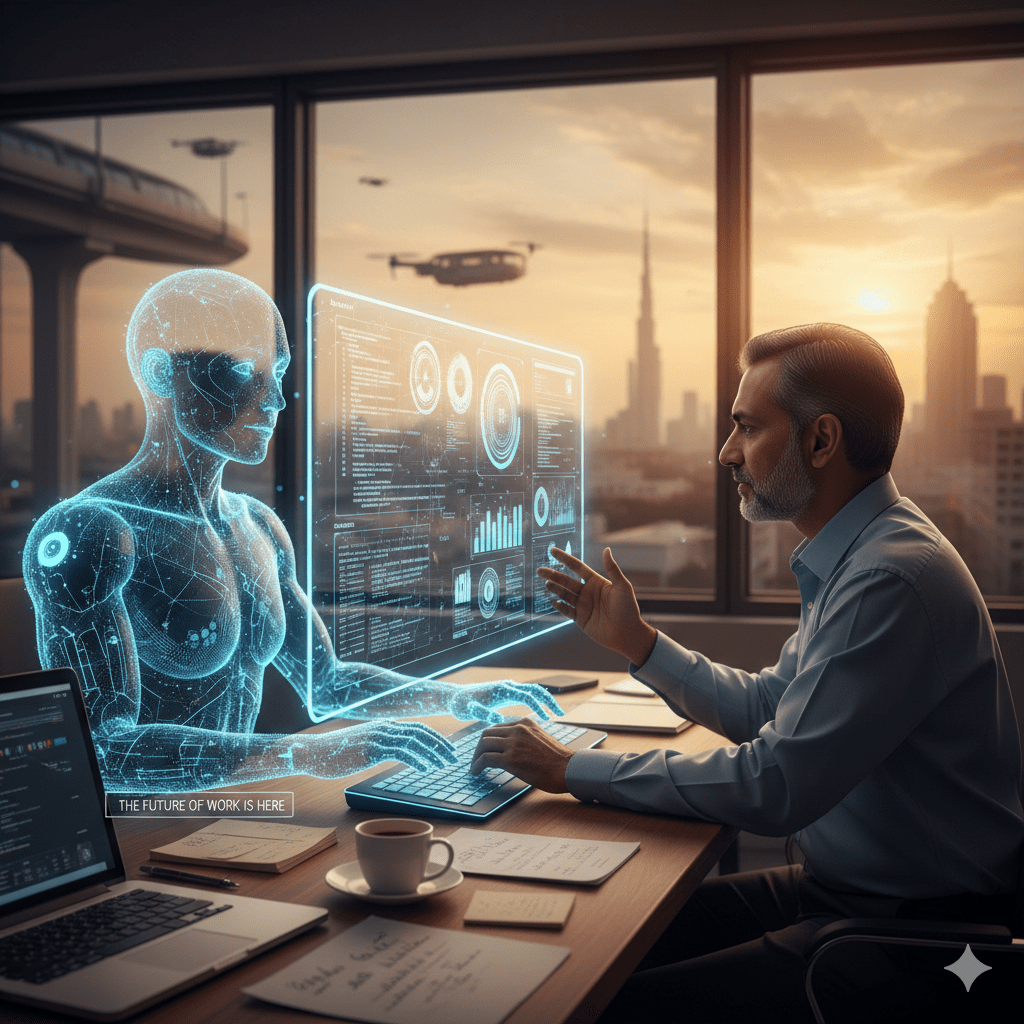
I’ve just finished reading Janakiram MSV’s thought-provoking piece on Forbes – “Microsoft Dreamed Of The Digital Coworker, Anthropic Built It”. And let me tell you, it’s not just a nice-to-read article, it’s a wake-up call for every single one of us in product management. We’ve been busy optimizing, tweaking, and fine-tuning, but the ground beneath our feet is shifting faster than a last-minute sprint deadline.
The article’s core message is clear – the AI landscape is evolving from “Copilot” (an assistant that helps us work) to “Coworker” (an agent that does the work for us).
So, after a good long think (and maybe a strong cup of filter coffee), here are my three key takeaways that we, as Product Managers, need to internalize and act upon, ASAP.
Shift Our Product North Star from “Efficiency” to “Agency” – It’s Not About Doing It Faster, It’s About Getting It Done
For years, our product roadmaps have been obsessed with efficiency. “How can we make this process 10% faster?”, “Can we reduce clicks by 2?”, “Let’s optimize the user flow for a smoother experience”. All good stuff, no doubt. But the future, my friends, is not just about making users more efficient, it’s about giving them agency. It’s about building products that can take a task, run with it, and deliver the outcome without constant hand-holding.
Let’s say we are building a CRM for small businesses. Traditionally, we would focus on making lead entry quicker, sales forecasting more accurate, or report generation more intuitive. That’s efficiency.
Now, imagine shifting to agency. Instead of just helping a user generate a sales report, what if CRM could,
- Identify dormant leads in the system.
- Craft personalized email outreach campaigns for them.
- Schedule follow-up tasks for the sales team.
- Automatically update the sales pipeline based on email responses.
- And finally, present a summary of the actions taken and results achieved, not just raw data.
The user isn’t just operating the CRM, they’re delegating an entire sales recovery workflow to it. This requires thinking beyond UI/UX to defining complete, autonomous job-to-be-done scenarios.
Prepare for the “UI-less” User Experience – Product Needs to Talk to Agents, Not Just Humans
This is a big one. It’s not about a user clicking buttons, it’s about an AI agent interacting with our product’s capabilities directly.
For us, this means the era of UI as the sole interaction point is evolving. Our products must be “agent-ready”. If an agent is going to be the primary consumer of our product’s functionalities, then our APIs, webhooks, and integration points become paramount.
Consider e-commerce platform for sellers. Today, a seller logs in, updates inventory, manages orders, and runs promotions through web or mobile app.
In an agent-driven world, a seller might simply tell their “Digital Coworker”: “My new shipment of sarees has arrived. Update inventory on the e-commerce platform, add new product photos from this folder, and launch a Diwali flash sale for 20% off on all Kanchipuram silks”.
For platform to support this, requirement will be,
- Robust and well-documented APIs for inventory updates, product creation, media uploads, and promotion management.
- Webhook capabilities – so platform can notify the agent of events (e.g., “New order received,” “Low stock alert”).
- Semantic understanding of API design – thinking about the intent behind actions, not just CRUD operations.
We need to start treating agents as legitimate users of our product, ensuring they can access and leverage our core functionalities programmatically. This isn’t just for developers anymore, it’s for every user who wants to delegate.
Re-evaluate Value Realization – Outcome is King, Not Seat Time
This one hits particularly close to home, especially for those of us in the SaaS space. Our traditional metrics often revolve around engagement: Daily Active Users (DAU), Monthly Active Users (MAU), time spent in the app, feature adoption rates. These metrics made sense when human interaction was central. But if an AI Coworker can complete a task in minutes that previously took hours or days of human effort, then “time spent in app” becomes a misleading indicator, doesn’t it? In fact, lower seat time might signal higher efficiency for the agent!
The value shifts from the effort expended to the outcome delivered.
Let’s take an example of a project management software (think Jira, ADO), where success metrics include task completion rates, project deadlines met, or user engagement with collaboration features.
Now, imagine an AI Coworker handling half the project tasks – creating sub-tasks, assigning routine items, updating statuses, flagging blockers, and generating summary reports.
- Traditional metric: “User X spent 5 hours this week updating project statuses”. (Good engagement?)
- New metric: “Project Y achieved 95% on-time completion with 70% of routine tasks autonomously handled by AI”. (Excellent outcome, less human grunt work!)
We need to pivot our thinking towards outcome-based metrics. What is the ultimate business value our product creates? Is it cost saved, revenue generated, Time to market reduced or Customer satisfaction increased? When an agent delivers that outcome, it’s a win, regardless of how many human eyeballs were glued to the screen.
#ProductManagement #AI #GenerativeAI #DigitalTransformation #ProductStrategy #AgenticAI #FutureOfWork #AIProductManagement #ProductLeadership #OutcomeBasedProduct





 Manish's - Thoughts and Learnings
Leave a comment